RAG vs AI Agents
Roman Meclazcke
Backend & IA Engineer
RAG gives an LLM documentary memory; an AI agent gives it the ability to act. This guide compares both architectures and when to combine them in a real product.
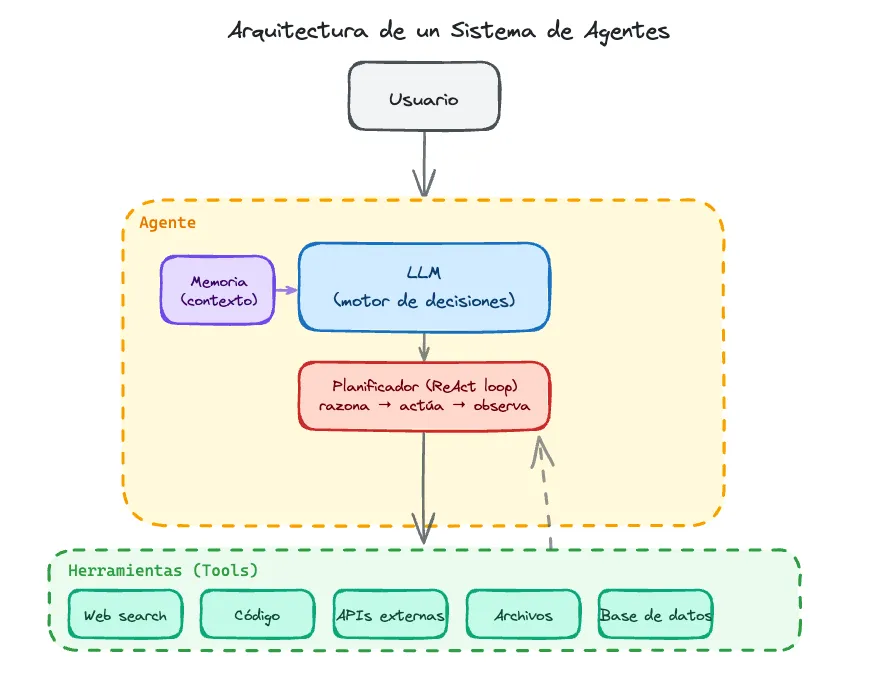
RAG retrieves documents and gives them to a model so it can answer with relevant context. An AI agent decides and executes actions through tools. They are not interchangeable: RAG covers memory, while an agent covers operation. In real systems, they are often combined.
Both use AI, but they solve different problems. Understanding that distinction makes it much easier to choose the right architecture for a product instead of adding an agent where a grounded answer is all that is needed.
What is a RAG system?
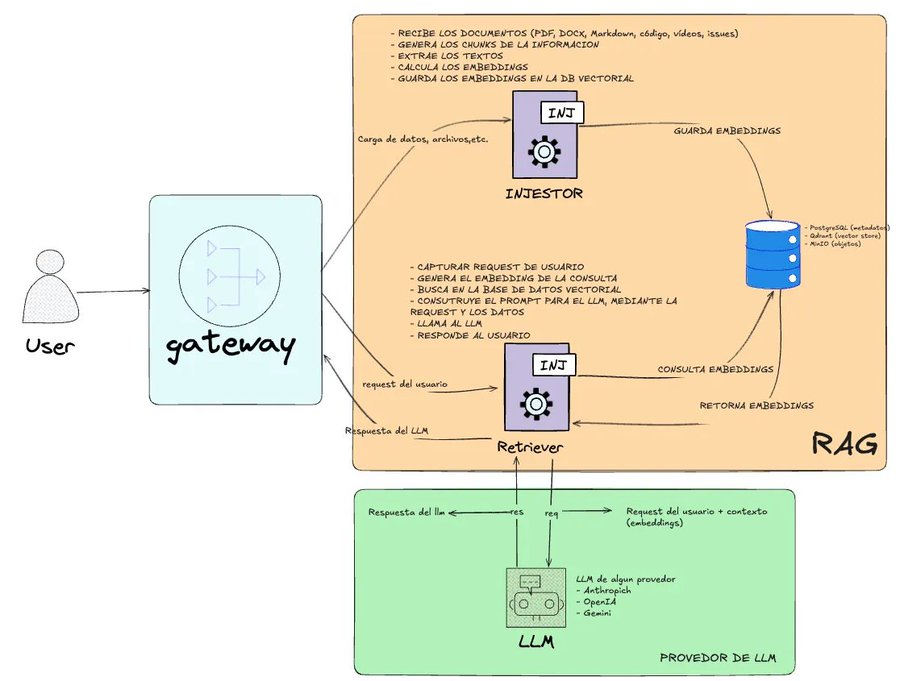
RAG, short for Retrieval Augmented Generation, combines information retrieval with text generation. Its flow can be summarized in four steps:
- A user asks a question.
- The system finds relevant information in a vector database.
- It injects that information as context for a language model.
- The LLM answers using both the question and the retrieved evidence.
What does it solve?
Language models have a training cutoff and do not automatically know a company's internal documentation, industry-specific details, or current information. RAG lets the model consult an external source before it answers: internal documentation, manuals, reports, articles, or other controlled sources.
Instead of replying only from its training, the model can respond from information the product explicitly provides. That is why RAG is useful for support assistants, internal knowledge bases, and any experience where answers need to be grounded and traceable.
Architecture and operation
Three components are essential:
1. The vector database
Documents are converted into numeric vectors called embeddings, which represent semantic meaning. A vector database stores those vectors alongside their original text and metadata.
2. Retrieval
The user's question also becomes an embedding. The system compares it to stored vectors and brings back the most semantically related pieces of text. It is searching for meaning, not just matching keywords.
3. Augmented generation
The retrieved information is added to the model prompt together with the original question. The LLM can then generate a more accurate answer based on enriched context.
What is an agent system?
An AI agent is a system where a language model does more than generate text. It can make decisions, invoke tools, and chain several steps to reach a goal. It may search the web, execute code, read or write files, call APIs, or coordinate with other agents.
The distinction is simple but important: RAG gives an LLM memory; an agent gives it the ability to act.
What does it solve?
An LLM by itself is reactive: it receives input, produces output, and stops. An agent can interact with external systems, observe results, and continue working. That makes it appropriate for workflows such as researching a topic, preparing a report, sending it by email, or operating a connected business process.
Architecture and operation
An agent commonly relies on three elements:
1. The LLM as a decision engine
In a RAG system the model receives context and writes an answer. In an agent, the model decides what to do next, chooses a tool, evaluates the result, and determines whether it has enough information to continue or finish.
2. Tools
Tools are the capabilities available to the agent: web search, code execution, a database query, an email action, or an external API. The agent selects one according to the current task.
3. The reasoning loop
The characteristic agent flow is:
reason -> act -> observe the result -> reason again
This loop continues until the task is complete. It is commonly associated with the ReAct pattern: reasoning plus acting.
Direct comparison
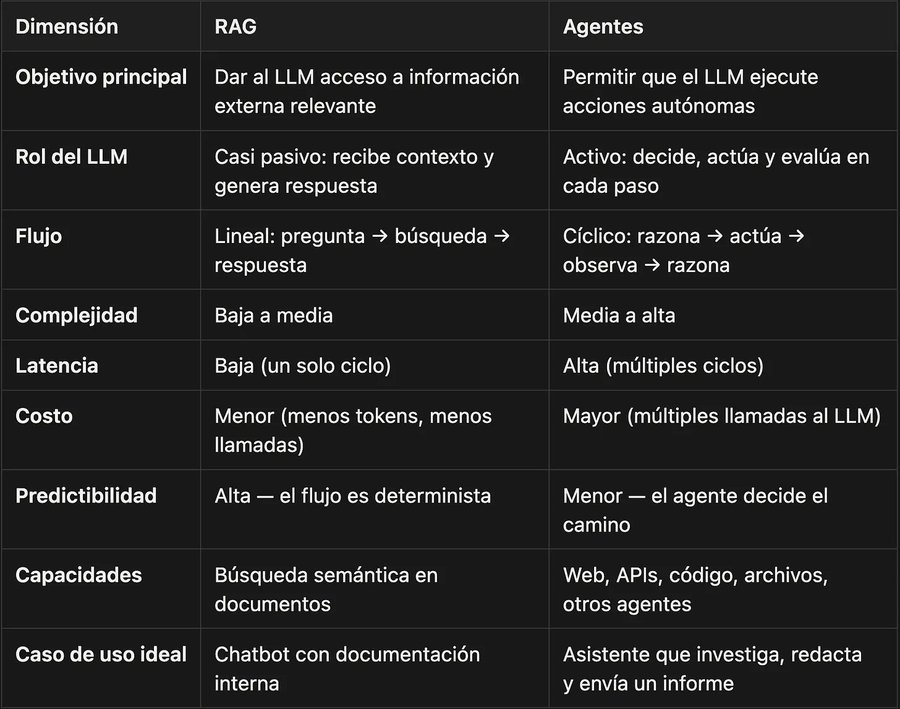
RAG is the better fit when the problem is answering with proprietary or updated information. An agent is the better fit when the model must perform operations: search, write, call APIs, modify files, or coordinate steps. A system can share the same LLM in both cases, but the model plays a different role.
Can they be combined?
Yes. In practice, RAG often becomes one tool inside an agent. When an agent needs company-specific information, it retrieves the relevant context and uses it to make a better decision before taking the next action.
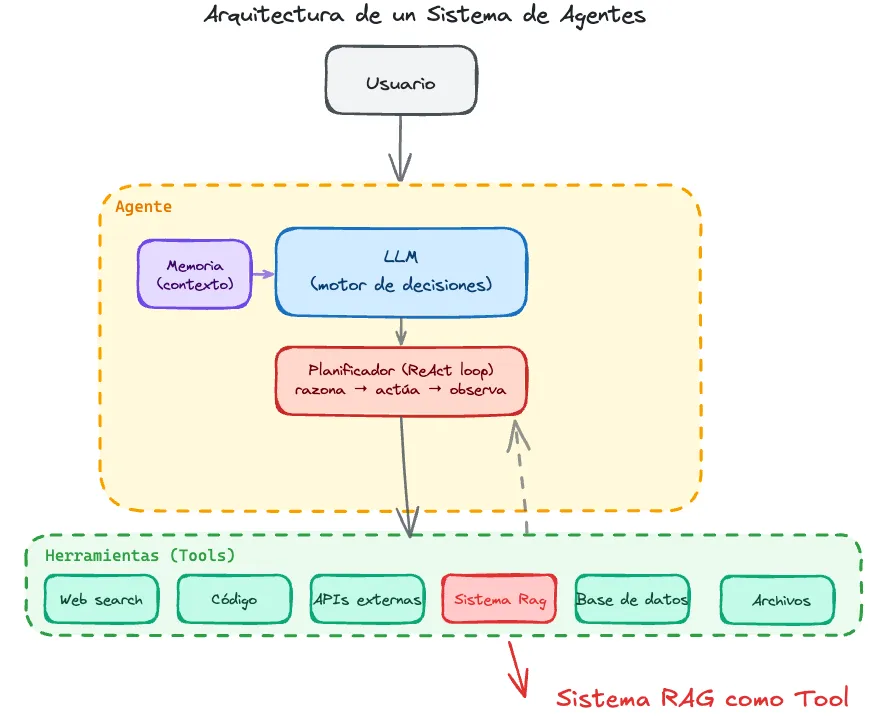
This pattern combines grounded knowledge with controlled action. It also makes responsibilities clearer: retrieval supplies evidence, while the agent handles decisions and operations.
If you want a deeper explanation of retrieval, start with What is a RAG system?. If an agent will read documents or browse the web, the next risk to understand is prompt injection.
Frequently asked questions
When should I use RAG and when should I use an agent?
Use RAG when the problem is answering from your own or current information. Use an agent when the model must search, write, call APIs, or chain steps. If you need both, let the agent invoke RAG as one of its tools.
Can RAG and agents be combined?
Yes. RAG often works as a tool in an agent system: the agent retrieves context when needed and then decides what to do with it. That improves decisions without treating retrieval itself as an operator.
Do RAG and agents use the same LLM?
They can. The role changes: in RAG the LLM produces an answer from retrieved context; in an agent it selects tools, observes results, and reasons again until the task is finished.