What is a RAG system and why it matters
Roman Meclazcke
Backend & IA Engineer
RAG stands for Retrieval Augmented Generation: it retrieves relevant documents and gives them to an LLM so it can answer with private, current, and traceable context.
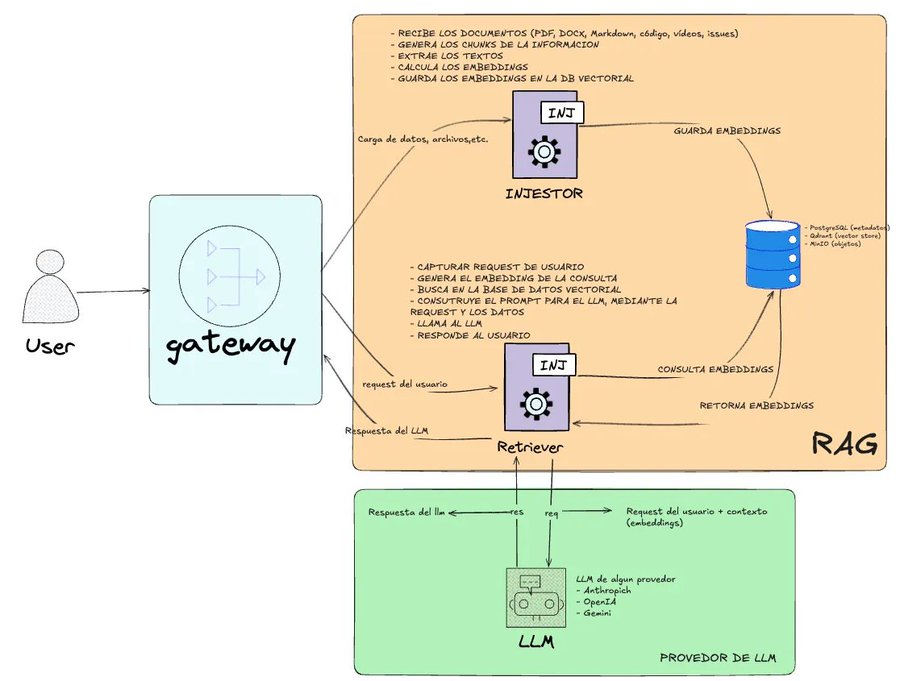
Retrieval Augmented Generation (RAG) is an AI architecture that retrieves relevant pieces of information before asking a language model to answer. It lets an LLM work with a company's documentation, private data, or current content instead of relying only on what it learned during training.
Large language models can write well, reason about many subjects, and hold natural conversations. By default, however, they do not know the details of a particular company, product, private knowledge base, or internal system. They also cannot guarantee that their knowledge is current. RAG connects an LLM's general capabilities with relevant external sources.
RAG does not try to make the model “know more” on its own. It gives the model the right context at the right moment.
What is a RAG system for?
RAG is useful when answers must use information that was not part of the model's original training. That matters in real products, where answers need to follow a business's documents, processes, policies, or data.
Common examples include:
- assistants over internal documentation
- conversational search for manuals and knowledge bases
- technical support grounded in product information
- policy, contract, or procedure lookup
- systems that need current or frequently changing information
Without this architecture, a model only answers from its training. That can be enough for general questions, but it falls short when a user needs precision, traceability, or domain knowledge. RAG adds an external context layer that improves the answer and lowers the risk of hallucinations.
RAG complements an LLM; it does not replace it. The model still interprets the question and writes the final answer, but it does so using a concrete documentary base.
The problem it solves
LLMs have a few structural limitations:
- Their knowledge has a cutoff date.
- They do not know private information unless it is provided.
- They can sound confident even when context is missing.
- They do not always distinguish accurate, outdated, and invented information.
RAG narrows the gap between a model's generative ability and the need to answer with reliable data. Instead of trusting the model's memory alone, the system retrieves relevant evidence first and then asks the model to build an answer around it.
The result is a system that can answer from specific sources, not merely one that sounds convincing.
How it works
A RAG system usually has two main stages: indexing and querying.
1. Indexing the information
Before the system can answer questions, it prepares the information it will search. Sources can include PDFs, web pages, knowledge bases, tickets, internal wikis, tables, or other relevant material.
The usual flow is:
- Extract content from the sources.
- Split it into smaller chunks.
- Turn each chunk into an embedding.
- Store embeddings, original text, and metadata in a vector database.
An embedding is a numeric representation of a text's meaning. It lets the system compare a question with documents by semantic similarity rather than exact keywords.
2. Retrieval at query time
When a person asks a question, the system follows a similar process:
- Convert the query into an embedding.
- Compare it with stored vectors.
- Retrieve the most semantically relevant chunks.
This is the retrieval step: it looks for related meaning, not just literal matches.
3. Generating the answer
The system then builds a prompt with the original question, the retrieved context, and instructions for the model. The LLM can now generate an answer that is more precise and grounded in the available information.
Why it improves answers
The benefit is not simply adding more text to a prompt. It is adding the right text, selected for the user's question. That can:
- reduce invented or out-of-context answers
- support answers about private or specific information
- use updated content without retraining the model
- improve consistency inside a domain
- make assistants useful for real products and teams
In practice, a model often fails not because it cannot write an answer, but because it cannot access the necessary information. RAG addresses exactly that limitation.
Typical RAG components
A RAG architecture commonly includes a data source, ingestion and cleaning, chunking, an embedding model, a vector database, a retrieval strategy, and an LLM for the final response. Depending on the use case, it may also need reranking, metadata filters, source citations, conversational memory, or automated evaluation.
Implementation considerations
RAG is not magic. Retrieval quality directly affects the final answer. Key choices include how documents are chunked, which embedding model is used, how many chunks are retrieved, how the prompt is written, and how noise is filtered out. A strong LLM will still answer poorly if it receives the wrong context.
Conclusion
RAG is one of the most useful architectures for bringing LLMs into real scenarios. It connects a model's generative ability with external, private, and current knowledge, making responses more useful inside a specific context.
If you are deciding between retrieving context and letting a model act, read RAG vs Agents. If a system will read third-party documents or emails, also review prompt injection.
Frequently asked questions
What does RAG mean?
RAG means Retrieval Augmented Generation. The system retrieves relevant information and gives it to the model before it answers, so the LLM works from concrete documents rather than training data alone.
Does RAG replace an AI agent?
No. RAG gives a model documentary memory, while an agent gives it the ability to act through tools. In production they are often combined: an agent consults RAG when it needs evidence and then decides the next step.
When should I implement RAG?
Use RAG when answers must align with internal documents, policies, tickets, or knowledge that changes without retraining the model. If the task is to send emails, call APIs, or edit files, you need an agent as well as—or instead of—retrieval.